Showing posts with label parenting. Show all posts

Wednesday, September 2, 2015

One Bite at a Time: 3 Tips for Preparing your Teen for College

A Monday night in our house: The rants. The tears. The fist shaking defiantly at the heavens.

And that's just me! Oh friend, hear me. Oh fellow parent on the road to releasing independent young adults (who will only return to visit), learn from me and what I could have done sooner if only I had listened to my own advice to other parents and students.

If you want to avoid the meltdowns that can come with getting your child accustomed  to the expectations of college professors than heed my call!

In this brave new world of increased access to dual enrollment more and more high schoolers are starting college early while still in high school. This can be a great opportunity but it's important to remember that they are taking bonafide college classes that count towards their permanent college transcript. Dual enrolling can help students transition to college life but it can be a very bumpy road if students are not prepared with some basic organizational life skills.

Here are my 3 Tips born out of the blood, sweat and tears of my own parenting experience and from teaching my students at EAL.

1) Check Emails Daily!
237% of all college work is online (slight exaggeration). Get your teen an email account and have them get in this daily habit.

If they don't have reason to check their email yet then sign them up for an e-newsletter they can read every day such as a devotional or news alert (tip: if they don't already read the news then this is a good way to introduce them to it, turn it into an assignment if you must).  Or send them a daily chore/task reminder for home responsibilities.

College professors communicate almost entirely online. Same for college administrators. Homework assignments are posted on line and the students submit them online. Assigned reading and discussion groups are also online.

This is true of bosses and co-workers in the work place so learn how to do it now!

Paper is an endangered species! Rare is the professor who provides a comprehensive syllabus in paper form that details ALL of the assignments. Don't be that kid who didn't check their email after a Thursday class until Monday night and discovered they had assignments due the previous Friday that weren't mentioned in class or on the paper syllabus. (Insert rants and raised fists here.)

2) Get A Planner....for your student- not you.
Teach your teen how to plan their time and organize all of their responsibilities with a planner (a week at a glance may be best but pick one that has room to write in).
http://media-cache-ak0.pinimg.com
/736x/d3/d6/bf/d3d6bf80e316881980bb980ba8c5c79b.jpg

College life is not predictable nor is it routine. Not like an 8-3, Monday- Friday class schedule. It can feel like that whip it carnival ride that flings your car in and out with no apparent rhyme or reason.

Help your child realize they need to budget their time and include time for travel, eating, rest, play, part time jobs, special interests (music, sports, etc.) in addition to class time and homework time.
  • List all of their fixed personal responsibilities first (i.e. classes, practices, job, etc.) on the calendar. Include travel time.
  • List fixed family and personal commitments (i.e. small group, church, dinners, etc.)
  • List times of rest.
  • Look at the available time left over and highlight it so they can see where they can do school work. Remind them they can fit some types of assignments into small windows of available time if they are intentional (i.e. waiting between class/practice, in the car if being driven, etc.)
  • Evaluate if anything needs to scrapped or adjusted.
This way when they check their emails daily they know WHEN they can finish that assignment they didn't expect because they have a full handle on how their time is spent.

They may prefer a calendar app eventually but it will probably work better to start them with a hard copy to master these skills first.

Tip: Our family is all connected to the same electronic calendar (we use Outlook) and all of our phones and emails accounts receive alerts about appointments, prayer requests or anything we all need to know about.
 
3) Teach them how to be their own advocate.
In college (and dual enrollment) you are not going to be there for them to plead their case to a professor or administrator when they get sick, have a computer crisis that prevents them from doing work or a learning disability that needs an accommodation.

Encourage them now to talk to and email their high school teachers, coaches, mentors or other adults who have authority in their life.

Put the responsibility for getting their work done, organizing their day, solving scheduling or assignment conflicts on them.

http://www.wordsonimages.com/pics/185853-W
inston+churchill%2C+quotes%2C+say.jpg
Guide them with suggestions for how to think through and solve every day problems of life. Share with them how you work through logistical conflicts so they know how to do it themselves.

If they have learning disabilities be sure to help them learn how to navigate the special needs department at their college and how to talk about what they need.

Preparing ourselves to be parents of young adults is as hard as it is to prepare our teens to be independent, responsible adults but you can do it!


Heather Flood has been homeschooling her 3 minions since 2003. She writes curriculum for Jill Dixon's Eclectic Academy of Learning and is the director/history teacher of the satellite campus in Rincon, GA. She has been teaching other peoples children since 2004. When not hanging out with kids and teenagers she can be found with her husband assisting adults pursuing hope for their future at their non-profit ministry Hope Academy of Savannah. And drinking coffee...lots and lots of coffee.

Sunday, September 21, 2014

Creative Learning Is Critical Thinking: "Skits, Cartoons & Interviews? What's with all this creative stuff?"

"Ugh! Mrs. Jill, Why do I have to write a paragraph like I'm one of the characters from this book? Why can't I just answer some questions about what happened?"
"Akk! Why does Mrs. Heather make us draw political cartoons for geography and history homework? I already answered the questions from the reading, why do I have to do this?"
"Blech! Mom, "History in Action" mini projects and writing trivia questions?!  Why can't we just do worksheets instead?"
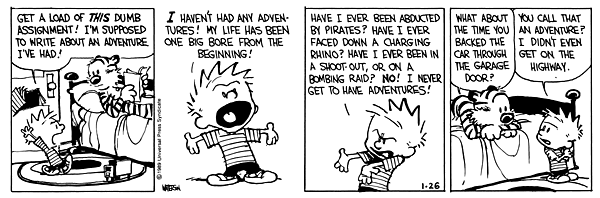
Students have a natural inclination to be creative already but when you make it 'homework' they may resist it.
http://img1.wikia.nocookie.net/__cb20130412040311/candh/images/5/53/Ch890126.gif


Imaginative writing, artistic expression and hands on projects usually thrill most of my students (especially elementary students and most homeschoolers) so it may be hard for you to believe but there are some students (usually high schoolers ) who don't like doing the 'fun' stuff built into the homework and class time at Jill Dixon's Eclectic Academy of Learning (EAL).

In fact, I've even had a rare parent question why we have so much fun in class and they occasionally wonder if we're learning anything when their teenagers come home saying they pretended to be living works of art or acted in a reality TV show about the settlers of Jamestown at class that day.  When having to make a choice about which assignments to complete these students or parents will skip the 'easy, fun stuff' in favor of the 'more serious learning' and traditional critical thinking questions.  (Please see notes at end of this article about what is recommended at EAL to complete for homework when pestilence or wanderlust descend upon your household.)

When my own family has to choose between assignments (usually because someone gets sick or we go out of town) I  will invariably choose the creative tasks every time because it benefits my students more in the long term than some of the other traditional learning expressions because  creativity requires higher thinking functions to complete them.

Wait, Mrs. Heather, did you just say the fun stuff is 'harder' than answering the questions?
Uncaging the Jabbering Parrot
Does Rodney's parrot understand what he is saying?
http://funny-pictures.picphotos.net/comics-funny-comics-strips-cartoons
-parrot-nose/img3.joyreactor.com*pics*post*comics-parrot-nose-535273.jpeg/
Yes, I did say that! Some may argue with me and please don't get me wrong.* Reading comprehension questions serve an important purpose but by themselves they are like a parrot in a cage repeating what is said around them. Does the parrot truly understand what it says?
Many times homework  questions are regurgitating facts* (not unlike a parrot) from the reading but the real critical thinking occurs when creativity happens.
When students have to "Make it Real" (an activity from Jill Dixon's Read With the Best literature curriculum) or complete another type of creative activity they are required to understand the material they have just read and be able to communicate what they have learned instead of parrot facts from a cage.
Creativity  is abstract thinking and forces the student to think beyond the facts of the story, such as in the "Make it Real" assignment from The Narrative of the Captivity of Mary Rowlandson, and imagine what else could have happened and what they might have done differently. In order to accurately write a paragraph about what would have happened if Mary Rowlandson had decided to approach her suffering in the complete opposite way of her world view the student must not just know how Mary Rowland  responded to suffering but understand why she made the choices she did. This type of activity requires both understanding and empathy which is critical thinking in action!
It's letting the parrot out of the cage so it can fly!
A student's cartoon depicting the boundary conflict
between New York & New Jersey over Ellis Island
shows they truly understand what happened.
This is HARDER than saying what happened (concrete thinking).  It requires truly thinking about what has been read and examining the narrative or the chronicle of history. The creative activities require students to conceptualize the facts and put them into a three dimensional world off of the page.  When this happens true comprehension and application takes place. 


It requires thoughtfulness and time which is usually why students (and sometimes parents) question the importance of these types of activities. Students have many tasks they must accomplish in their studies and it's easy to be short sighted when our 'to do' list feels very long. We want to check things off as fast as we can and get it done.
That's fine when checking off chores or a items from a shopping list but is that the only thing we want to teach our children? 
If our end goal is to enable our children to engage the world rather than be passive observers and be able to evaluate the very real problems they will face as adults then we need to teach them how to think critically and to understand the people they will live life with.  
Those are abilities and skills that can't be checked off a list but require time and effort as we challenge them to go beyond parrot jabber.
At the end of the day I want to make sure my students will be able to fly when the cage door opens.
Found at: http://media-cache-ak0.pinimg.com/originals/e9/fc/2e/e9fc2ead7103009ef06d288a39f39427.jpg
*When I say reading comprehension questions are regurgitating facts I am not referring to the application questions or short answer essay questions that require analysis. Rather, I am referring to questions that repeat facts from the reading such as the Who, What, When questions instead of the Why questions that analyze reasons why people or characters made the choices they made or How their choices impacted people around them. Those types of Why and How questions are incredibly important as I discuss in my blog "I Hate Poetry: The Importance of Humanities."
Important Note to EAL Parents about skipping homework assignments:
Some weeks we can't get all of the assignments done and must make a choice. Usually this is because little Hezekiah has the plague or your family has the opportunity to visit Aunt Ethel and Uncle Shamus in Glasgow. This is when I'm asked, 'What homework should we get done?" This is discussed at length in the information packet you received at orientation but the short version is:
  • Get the literature and history reading done  
  • Complete the writing assignments (if at all possible)
  • Do the creative assignments for history and literature 
  • Be sure to have your student go back and cover any material that will be tested.
  • Alternatively, do some of all homework sections (i.e.- odd numbered "?'s" instead of every "?")
  • Always communicate and excuse incomplete homework on the weekly assignment sheet
  • If students are going to have a lengthy absence because of severe illness or extended travel then please speak with the director to come up with a specific plan for your family and situation.
Why do these specific assignments:
~If they get the reading done then they have the content and can participate in class discussions.
~If they get the creative assignments done they will also be able to participate in class activities.
 ~Writing skills are often one of the primary reasons people enroll in EAL so don't get too far behind in that if at all possible but if a student has been keeping up with most writing assignments and has strong writing skills they will be okay if they miss one assignment. ***However, if they are working on their research paper in high school or their annual writing project in the younger class then they will have to make up writing assignments to avoid being behind.***
~Doing part of each type of homework assignment still reduces the work load but enables the student to participate in class and maintain or establish a routine (in the case of students with special needs).
When doing this be sure to complete all of the work that is tested on and reduce the load else where.


Saturday, February 15, 2014

Moving Stones: I think my child has a learning disability, what now? Tips and answers from a mom who's been there.

This series of Moving Stones is about getting the stones that litter our field out of the way so our children can grow. Sometimes those stones are learning disabilities and attention differences. These stones can appear to be boulders but with the right tools they can be reduced to pebbles. Here are some questions I'm often asked and resources I've used to help my own and other students.

Disclaimer: These are my opinions. I am not an expert, just a mom who has 3 children with  either Asperger's, learning or attention differences. These opinions are based on what worked for my family and meant to encourage you to find the resources that will work for your family.

Should I have my child tested/diagnosed?
Yes. It's very hard to help our children if we don't have the proper diagnosis. When my son was 7 we had him diagnosed by a child psychologist but the diagnosis was inaccurate. We did not receive the proper diagnosis until he was 10. Those 3 years with the wrong diagnosis meant we were only treating symptoms of the problem and not the source. We made some progress during this time but other things became worse. Once we identified the source of his problems we were able to help him more effectively and began to make real progress.

I home school so I already make accommodations for her, why do I need a diagnosis?
A diagnosis is necessary for a child or an adult to receive the rights afforded to them by the Americans with Disabilities Act.  Your child will not always be at home. If your child is going to go to college or technical school they may need accommodations but if they don't have a diagnosis they may not be entitled to it. Want them to receive special accommodations for the SAT like a test reader or no time limit? You need a documented disability. If your college student needs to have a special test environment they need a diagnosis to get what they need from the college. Without a diagnosis the college does not have to give them what they need and depending on the professor, the school, their funding and resources they may not give it to your child. Which is better: having a tool and never needing it or not having the tool  when you need it?

How do I get my child diagnosed?
My first choice is a child psychologist and very often this is covered by health insurance under mental health coverage. If you are in the Savannah, Georgia area I recommend the Savannah Child Study Center.
  • Contact your insurance provider to verify your coverage.
  • Talk to other parents of special needs children to get referrals to a psychologist who has a good reputation for diagnosing learning disabilities. 
  • Do some homework before you go. Learn about different learning difficulties and observe your own child's specific struggles so you can work with your psychologist to pin point where the glitch is happening.
I recommend Jill Dixon's The Homeschooler's Guide for Learning Problems- Practical Tips For Daily Success. She explains in easy to understand terms the different glitches and what is happening in the brain.  This will help you understand what the psychologist is saying and be able to work with them to come up with a plan to help your child.

She also has a great tool for Verifying Special Needs on her website.

Should I go to the school system to get my child diagnosed or for services?
That is a personal decision. Some homeschoolers are concerned about possible hostility or interference with their decision to home school if they use the public schools for a diagnosis or special needs services.

First it depends on your state because not every state will give these services to homeschoolers. I understand why people may be concerned and this is a decision only you can make for what is right for your family. Talk with other families in your community to see what the climate is like in your neighborhood school. In my community I have not heard of a home school family being 'visited' because they used the school system for special needs help. I've heard of some teachers not being supportive of homeschooling or not understanding why a family chooses that but I have not heard of harassment. I've also heard of wonderful special education teachers helping home school families. I believe it varies from teacher to teacher and school to school.

My opinion is this, if my child needs help then I will get them that help wherever I can get it from. I did not use the school system but I wish I had gotten my children help sooner.  Wisdom and caution are not the same thing as fear. My fear interfered with some of my decisions and a decision based on fear is often not the wisest decision.

I have a diagnosis, now what?


http://www.edudps.com/learningproblems.html
Don't let the simple cover fool you,
these guides transformed my home.
A frequent challenge is that a psychologist will give you a diagnosis but they may not tell you what to do with it to help your child. I bumbled around in the dark for a long time trying to find resources to help me help my kids and then I heard education consultant Jill Dixon speak. Everything changed for me and my ability to help my kids after I discovered her guides. They are easy to understand, not filled with fluff and give real suggestions to use with your child to help them learn!

These are my top 3 tools in my tool box for helping my special needs children:
What other resources do you suggest?
Here are a few I've used with success AFTER I identified their learning style and learning glitch. Identifying these two things is, in my opinion, the most important first steps. Skipping these steps will only lead to frustration.  Below are just a few of the tips I've found in Jill Dixon's guides.  I don't include her tips for Visual Learners because most commonly used curriculum are already designed this way. Very often learning and attention differences are improved by using auditory and tactile approaches.

Note: Test yourself for your learning style also. I've observed that one of the leading factors in frustration between teacher and student is when the teacher has a different learning style than the student. We teach in the same way we learn. Teachers who learn to teach according to the styles of their students find positive results. 

Auditory Learners:
  • Leap Frog Videos helped my daughter reinforce the symbol with the sound (she watched it EVERY day for months and months before she finally was able to make a solid connection).
  • Alpha Phonics and Phonics Pathways were the most effective tools for my two dyslexic children. It emphasizes word families. AVKO Sequential Spelling is also good.
  • Choral Reading is a method where the teacher/parent reads a passage aloud and then the child reads the passage aloud. At first I thought my son might have been reciting what I was saying and not reading but then I realized he really was reading.
  • Use flash cards for reading and math- make sure they are saying them aloud. Use a timer with the math facts and keep a record of their time so they can see tangible proof of their improvement.  My daughter recognized her improvement was from regular practice and her regression was from neglecting daily math and not just me nagging.
  • Increase reading comprehension by having children 'narrate' the story back to you (they tell you in their own words what they read or heard) or tell the story to their siblings.
  • Audio books transformed my daughter's reading ability. The trick is to have them listen AND read along with  the hard copy. I talk more about this in my blog about cultivating a love of reading.
Tactile/Kinesthetic Learners:
  • Use manipulatives to teach spelling, word families and math facts/concepts.
  • Tactile learners benefit from stimulating their fingertips with different textures. An example of this would be to have them write words or math facts in a tray full of Jell-o mix or sand.
  • Help memorize math facts, sight words or letters by pounding golf tees or tacks into a cork board labeled with words.
  • Help reading comprehension by having child act out scenes from a story or use Legos to build a scene or characters from the story.
  • Build math story problems with Legos or other manipulatives.
Reading Comprehension:
To improve reading comprehension it helps to separate the mechanics of reading from having to comprehend the story. I talk more about that here but the short version is dyslexics brains are wired differently and they must work harder than the average reader just to decode the symbols on a page let alone understand their complex meaning.

http://www.edudps.com/jill-dixon-eclectic-academy-of-learning.html
Acting out stories is fun &
helps  with comprehension.
  • Read stories aloud or use auditory books while children play with legos, clay, paint, or other tactile stimulation.
  • Pause to ask them questions about the story as you go.
  • Read aloud comprehension questions BEFORE you read the story. Tell children to 'listen' for the answer as you go along. Younger students should only be asked to look for one or two questions at a time, ask questions as you go along through the story.
  • Have children act out or draw scenes or thematic concepts from the story.
Encourage Story Telling & Creative Writing:
Read more about how this looks in my house here. By giving kids room to tell their own stories (and listening to them) you will encourage them to want to read other people's stories. Learning to write helps cultivate reading.
    http://www.edudps.com/wwtb.htmlhttp://www.edudps.com/rootsandfruits.html
  • We use Write With the Best because it breaks down the most important aspects of why good writing is good and it has a track record for successfully helping reluctant writers as well as special needs writers. (I've used both Volume 1 & 2, we've re-used them every year for the last 8 years.)
  • Cultivate Vocabulary with Roots & Fruits. There are creative and fun reproducible worksheets to make vocabulary 3 dimensional and you can use this book every year (buy it once and your done!). My kids favorite is the Silly Sentence. My son picked a group of characters who he wrote silly sentences about every week using his weekly vocabulary words. The adventures of Alligator, Tiger, Koala and Ewok continue to be one of my favorite memories of home schooling  along with the continuing problems of my daughter's Elf labor union who fought regularly against the injustice of toy and cookie factories. We laughed and they learned.
  • Creative writing is a right brain activity but the act of physically writing is left brain. I separated these two activities by having my children dictate their stories to me. This freed up their creative juices from the very difficult task of hand writing, spelling and reading. It built their confidence as writers and made them want to read. (I'm not an advocate of multi-tasking when it comes to learning, especially regarding special needs learners.)
The Best for Last.
Take a deep breath. Let it out. Remember to breath. Now relax. Your children need you to breath and relax. I mean it when I say that everything is going to be alright. Your children will not end up as hobos. You are actively pursuing help one step at a time which makes you the best advocate for your child. You don't have to do this by yourself.

I truly believe it is not my job as a parent to be the expert on everything or do everything myself. My job is to move stones so my children can grow.-


\