Showing posts with label learning styles. Show all posts

Sunday, September 21, 2014

Creative Learning Is Critical Thinking: "Skits, Cartoons & Interviews? What's with all this creative stuff?"

"Ugh! Mrs. Jill, Why do I have to write a paragraph like I'm one of the characters from this book? Why can't I just answer some questions about what happened?"
"Akk! Why does Mrs. Heather make us draw political cartoons for geography and history homework? I already answered the questions from the reading, why do I have to do this?"
"Blech! Mom, "History in Action" mini projects and writing trivia questions?!  Why can't we just do worksheets instead?"
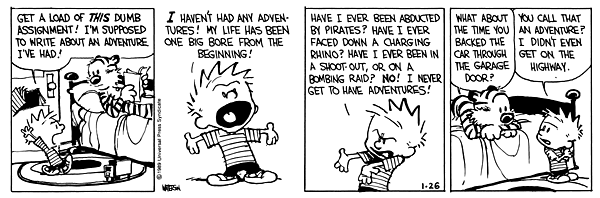
Students have a natural inclination to be creative already but when you make it 'homework' they may resist it.
http://img1.wikia.nocookie.net/__cb20130412040311/candh/images/5/53/Ch890126.gif


Imaginative writing, artistic expression and hands on projects usually thrill most of my students (especially elementary students and most homeschoolers) so it may be hard for you to believe but there are some students (usually high schoolers ) who don't like doing the 'fun' stuff built into the homework and class time at Jill Dixon's Eclectic Academy of Learning (EAL).

In fact, I've even had a rare parent question why we have so much fun in class and they occasionally wonder if we're learning anything when their teenagers come home saying they pretended to be living works of art or acted in a reality TV show about the settlers of Jamestown at class that day.  When having to make a choice about which assignments to complete these students or parents will skip the 'easy, fun stuff' in favor of the 'more serious learning' and traditional critical thinking questions.  (Please see notes at end of this article about what is recommended at EAL to complete for homework when pestilence or wanderlust descend upon your household.)

When my own family has to choose between assignments (usually because someone gets sick or we go out of town) I  will invariably choose the creative tasks every time because it benefits my students more in the long term than some of the other traditional learning expressions because  creativity requires higher thinking functions to complete them.

Wait, Mrs. Heather, did you just say the fun stuff is 'harder' than answering the questions?
Uncaging the Jabbering Parrot
Does Rodney's parrot understand what he is saying?
http://funny-pictures.picphotos.net/comics-funny-comics-strips-cartoons
-parrot-nose/img3.joyreactor.com*pics*post*comics-parrot-nose-535273.jpeg/
Yes, I did say that! Some may argue with me and please don't get me wrong.* Reading comprehension questions serve an important purpose but by themselves they are like a parrot in a cage repeating what is said around them. Does the parrot truly understand what it says?
Many times homework  questions are regurgitating facts* (not unlike a parrot) from the reading but the real critical thinking occurs when creativity happens.
When students have to "Make it Real" (an activity from Jill Dixon's Read With the Best literature curriculum) or complete another type of creative activity they are required to understand the material they have just read and be able to communicate what they have learned instead of parrot facts from a cage.
Creativity  is abstract thinking and forces the student to think beyond the facts of the story, such as in the "Make it Real" assignment from The Narrative of the Captivity of Mary Rowlandson, and imagine what else could have happened and what they might have done differently. In order to accurately write a paragraph about what would have happened if Mary Rowlandson had decided to approach her suffering in the complete opposite way of her world view the student must not just know how Mary Rowland  responded to suffering but understand why she made the choices she did. This type of activity requires both understanding and empathy which is critical thinking in action!
It's letting the parrot out of the cage so it can fly!
A student's cartoon depicting the boundary conflict
between New York & New Jersey over Ellis Island
shows they truly understand what happened.
This is HARDER than saying what happened (concrete thinking).  It requires truly thinking about what has been read and examining the narrative or the chronicle of history. The creative activities require students to conceptualize the facts and put them into a three dimensional world off of the page.  When this happens true comprehension and application takes place. 


It requires thoughtfulness and time which is usually why students (and sometimes parents) question the importance of these types of activities. Students have many tasks they must accomplish in their studies and it's easy to be short sighted when our 'to do' list feels very long. We want to check things off as fast as we can and get it done.
That's fine when checking off chores or a items from a shopping list but is that the only thing we want to teach our children? 
If our end goal is to enable our children to engage the world rather than be passive observers and be able to evaluate the very real problems they will face as adults then we need to teach them how to think critically and to understand the people they will live life with.  
Those are abilities and skills that can't be checked off a list but require time and effort as we challenge them to go beyond parrot jabber.
At the end of the day I want to make sure my students will be able to fly when the cage door opens.
Found at: http://media-cache-ak0.pinimg.com/originals/e9/fc/2e/e9fc2ead7103009ef06d288a39f39427.jpg
*When I say reading comprehension questions are regurgitating facts I am not referring to the application questions or short answer essay questions that require analysis. Rather, I am referring to questions that repeat facts from the reading such as the Who, What, When questions instead of the Why questions that analyze reasons why people or characters made the choices they made or How their choices impacted people around them. Those types of Why and How questions are incredibly important as I discuss in my blog "I Hate Poetry: The Importance of Humanities."
Important Note to EAL Parents about skipping homework assignments:
Some weeks we can't get all of the assignments done and must make a choice. Usually this is because little Hezekiah has the plague or your family has the opportunity to visit Aunt Ethel and Uncle Shamus in Glasgow. This is when I'm asked, 'What homework should we get done?" This is discussed at length in the information packet you received at orientation but the short version is:
  • Get the literature and history reading done  
  • Complete the writing assignments (if at all possible)
  • Do the creative assignments for history and literature 
  • Be sure to have your student go back and cover any material that will be tested.
  • Alternatively, do some of all homework sections (i.e.- odd numbered "?'s" instead of every "?")
  • Always communicate and excuse incomplete homework on the weekly assignment sheet
  • If students are going to have a lengthy absence because of severe illness or extended travel then please speak with the director to come up with a specific plan for your family and situation.
Why do these specific assignments:
~If they get the reading done then they have the content and can participate in class discussions.
~If they get the creative assignments done they will also be able to participate in class activities.
 ~Writing skills are often one of the primary reasons people enroll in EAL so don't get too far behind in that if at all possible but if a student has been keeping up with most writing assignments and has strong writing skills they will be okay if they miss one assignment. ***However, if they are working on their research paper in high school or their annual writing project in the younger class then they will have to make up writing assignments to avoid being behind.***
~Doing part of each type of homework assignment still reduces the work load but enables the student to participate in class and maintain or establish a routine (in the case of students with special needs).
When doing this be sure to complete all of the work that is tested on and reduce the load else where.


Thursday, July 17, 2014

One Bite at a Time: 3 Tips for Teaching Auditory Learners

"Jehoshaphat, how can you do your home work with those ear buds in your ears?"
"Marigold, can you please stop talking for two minutes?"
"Angus, Why can't you go read a book?!"

These are just some examples of exasperation from parents of auditory learners. It's likely the moms or dads exclaiming questions like these are not auditory learners* themselves and, probably just as likely, Mom or Dad are visual learners. When visual learning teachers communicate with auditory learners it can often feel as if they are speaking different languages without an interpreter. Today I'll attempt to be your interpreter with at least these three common frustrations.

Q: How can you possibly learn with all that 'noise'?
A: How can they learn without it? If auditory learners are stopped from learning through stimulating their auditory senses (listening or speaking) then they will STOP LEARNING!

Let them listen to music while reading or working BUT it should be instrumental music or light on the lyrics.  Catchy phrases (i.e.- earworms) will create more of a distraction, especially for anyone with ADD.  One of my kids loves to listen to the sound tracks of video games like Kingdom Hearts or Zelda. Keep the volume low to create a 'white noise' or just loud enough to drown out other distractions in the house.

Another option is a soundscape app such as this one that creates ambient noise. This would be very effective for people with ADD or studying in an environment with distractions (can you say 'siblings').

Q: How can I get my child to stop talking all the time while I'm trying to teach her?
A: Don't stop her. Redirect her. Give her an outlet to talk about what she's learned.

History Study Group:They don't look
 like they are having fun but they are.

Little siblings come in handy if you can find one. Auditory learners will be able to reinforce what they've learned if they can talk about it by teaching someone else. Have them make a video or skit to summarize what they've learned. Do an oral report; just be sure to have an attentive audience or this won't work well.

Charlotte Mason's narration technique is fantastic for auditory learners. The child reflects back to the parent what they have learned by telling you everything they remember about what they just learned whether that is cuttlefish, pharaohs or Wilbur from Charlotte's Web. Use critical reading questions from your curriculum as a leaping off point.

Learn Out Loud! Join or start a study group. This is a huge boon for teenagers. The energy of being with a couple of other kids and the discussion based learning that results is just what they need. Reading out loud together and discussing the assignment energizes an auditory learner.
Q: Reading assignments result in World War 3 in my house. How can I make my child read more?
A: Have them read less.  Seems counter intuitive but find as many resources as you can to reduce and augment reading with listening. (For more about cultivating reading follow the link to my blog post.)

Use audio books BUT have them read along with the hard copy whenever possible. Older students should read along while listening AND take notes as they read in their book highlighting important information (this pairs their secondary style of visual or tactile with their auditory and reinforces their reading skills).  Audible (a subscription service) and Librivox (free auditory books in the public domain) are my 'go to' tools. Libraries often have audio books but you can run into availability issues. My dyslexic daughter has re-read most of the audio books we purchased with our subscription which delights this mama and now she reads for fun without the audio books and reads most of her textbooks (albeit slower).

Watch documentaries. Isn't that visual? Actually it's both. If your child is an auditory learner they can likely recite to you the entire dialogue from Star Wars Episode IV: A New Hope without hesitating.  Whenever possible I supplement our studies with documentaries from Netflix and YouTube.

These are just a few bite sized nuggets for tweaking how you teach your auditory learner. I would love to hear your own tips, tricks and trade secrets for teaching according to learning styles so be sure to comment. You can also check out my Pinterest board "Eclectic Learning Styles".

*RESOURCES:  There are lots of tips for teaching an auditory learner found on the internet and in great resources available about learning styles. Identifying my children's learning styles and teaching them accordingly has reduced the level of stress in my home and resulted in REAL learning. A popular book about learning styles is The Way They Learn by Cynthia Tobias. If you want real world suggestions for teaching different learning styles I recommend Jill Dixon's Concise Learning Style's Assessment or POC4U (includes assessments, tips AND suggestions for curriculum matched to learning styles).  POC4U saved me time, money and my sanity. No joke.

Friday, April 18, 2014

Moving Stones: Intentionality Prevents Stress-...suggestions for preparing for next year now


We're all pretty full of Spring around here and counting the nanoseconds to the last day of school. Maybe you're feeling burnt out or have the April Blahs like I did. Here's a blog I wrote about overcoming burn out last week and below are some tips our family uses for preventing burn out next year.
**Our family uses a reward program we started after completing a special 15 week program called Second Step at Savannah Child Study Center several years ago for our son with Asperger's. There are very specific steps and a structure which was very helpful for two ADD parents raising attention challenged kids. One of these days I will write more about the rewards and about the program. If your child has Asperger's, Autism, ADD, or emotional management issues then I cannot recommend enough the program at SCSC with Bonnie Craven. My 17 year old son would tell you that program was the most effective therapy we ever participated in and changed his life.  I truly thank God for leading our family there.


Wednesday, February 5, 2014

Why Test & Study Skills are Important Or "Another one? Why do I have to take all these tests?"

 
I have been teaching other people's students for 10 years and I hear a lot of questions about tests (read: complaints).  Below are a few examples of those questions, my explanation to most of them and how we prepare you at Jill Dixon's Eclectic Academy of Learning to prepare for tests. (See specific information about tests at EAL further in this article- it's long but will answer most if not all of your questions about tests.)
 
Let me be clear, I do not believe tests are always an accurate indicator of mastery of a subject. The dominant test formats do not afford  the different learning modalities to show what every student may know about a subject. However, tests are the primary method for entrance and advancement in most colleges/careers and they are here to stay.  I've seen many intelligent students be able to communicate their extensive knowledge of a subject with oration or projects but they were terrible test takers and had to jump through hoops to try and enter college because their tests did not reflect what they knew. Students must learn how to prepare for and take tests. This doesn't come naturally to most students and some students succeed not because they were taught how to take tests but because their learning styles match the test format.


Calvin should practice study/test skills.
Identify Learning Style For Testing Advantage
I was a very good test taker in school primarily because my learning styles meshed well with the teaching styles of my teachers and with the most popular forms of test giving (ie- visual). I'm also a strong tactile and auditory learner so while I do have excellent note taking skills they also stick with me because I remember what I hear, what I physically experience (writing notes) and what I see.


I score almost evenly in all three learning styles but this is rare and a great advantage that most people do not have which reflects in their test taking. For auditory and tactile learners who must take visual tests it is akin to someone having to take a test in a language they don't read. It doesn't matter that I am an expert in 'The Art of Drinking Coffee' if the test is in Mandarin or Binary Code (two languages I have yet to master) I will probably fail.
 
Identify and Transform Challenges Into Strengths

Find  resources to help you
maximize your challenges!
So now you've realized your learning style doesn't jive with the test format but what about other challenges? I don't have learning disabilities (LD) but many of my students do and they have either embraced their differences by finding ways to cope and maximize these challenges or they throw in the towel. Please don't do that. People with LDs have a gift for thinking outside the box and approaching problem solving from a different perspective that is a strength! There are advantages to having LDs or attention differences. My ADD tendencies  can be an advantage when I get hyper focused on one thing I can become an expert on whatever I'm focusing on. I was also a procrastinator of the first order which didn't impact me as much in high school but knocked me upside the head when I entered college. I learned on my own how to take notes and how to prepare for a test. No one taught me and that was hard, I don't want you to go through that so please take what I share here to heart.

Two 'take aways': It's is imperative to 1) know your learning style so you can in put information into your brain the way you learn and 2) learn how to study and how to take all types of tests.

FAQs from my high school students:
Mrs. Heather, why don't we get study guides or review sheets for all of our tests? How come we take all these different tests? They are annoying and some of them are harder for me than others but I can't figure out why. And tests are stupid, I know this stuff when we talk about it in class but when you give me a test I can't put it on paper. You said tests don't always show mastery so what's the point? 
 
Answer:
Look at this home school graduate who has learned
how to study and prepare for college.
Doesn't he look happy because he listened to
Mrs. Heather and Miss Hannah?
The Eclectic Academy of Learning gives you a variety of test taking and test preparation experiences to mirror what you will likely experience in college. The more exposure you have to tests the more likely you will know how to interact with them in a successful way (note: this is why we expose even our youngest students to tests). The homework assignments have been designed to help you practice study and time management skills that can be applied to other subjects. Every year EAL alumni return to say how 'Mrs. Jill's Class' gave them the skills they need to succeed in college and that is true of both advanced students and students with learning differences**.
 
Prepare As You Go from Day 1
Your professors will employ a variety of testing styles that require different styles of test prep in college. Most WILL NOT give you a study guide but will give you a syllabus telling you what you will be responsible to know for the entire semester, when it is due and when tests are. Don't count on them to remind you, most won't.

It is the student's responsibility to own their educational journey and seek out the knowledge they need, not the teacher's or the parent's (who won't be there when you are in college) but yours. The sooner you learn this the better off you will be.
Part of test preparedness means preparing from the first time a topic is introduced which is often weeks before a test.
This is your brain when you cram.
See how everything is falling out?
That's not very helpful.
You do this by:
  • taking notes in class
  • completing assignments on time
  • reviewing information from previous weeks (not just looking at the current week and waiting to cram past information in right before the test).
  • doing assignments over several days to allow your brain to 'build pathways' instead of trying to do all of your work in one day and overwhelming your brain with information it can't hold; like a soaked sponge it will drip out.    
Know When Tests are Coming: Read the Weekly Assignment Sheet & Look Ahead!
Weekly assignment sheets tell you when the tests are and what material is covered. Look at the entire semester's course pack and make sure you know when tests are coming so you can prepare as you go.
Your assignment sheet always tells you where to find the information you need for all of your tests either by saying which topic it is (i.e. Literary Terms and the weeks covered) or where the test is (chapter in a book).

Study Guides: Make your own and study via your learning style
It is nice to have a study guide or a word bank to refer to but in college you will most likely need to create your own study guide (sometimes one will be provided for you at EAL but it is your responsibility to know what will be on the test so don't count on it).

At EAL we teach you to start this right from the beginning. For example, your weekly vocabulary words are placed in a notebook, spiral index cards or typed up and placed in a central location depending on your learning style.

Study Guides You Build Yourself at EAL & Types of Tests:
EAL uses different formats to reflect some of the tests you will need to take in college and career. Some tests will be multiple choice or short answer only (World History the Easy Way, SAT practice) or essay (SAT in class practice, government). Some will rely heavily on memorization (such as our matching tests). Some will require critical thinking (such as our word usage section on the vocabulary tests and history short answers). Many will require you to communicate your understanding of a subject (short answer tests/homework questions, essay assignments, class discussion/debates).

Here are some of the ways we help you "learn how to learn" by studying as you go.

Vocabulary notebook of roots and weekly words definitions (visual/tactile may illustrate meanings, auditory write silly sentences).
Test is matching roots from a word bank to definitions and identifying how vocabulary words are used in sentences.
Century Book with timeline and biography terms provided in handout at front of history course pack for the entire semester(visual/tactile may illustrate meanings, auditory should use Time Rhymes handed out in class).
Test is matching terms from a word bank to definitions and answering a short answer format question regarding significance of historical figures or events as discussed in class and in homework (see next section about this).
Idioms notebook where you write or type the definitions of idioms from Dictionary of Cultural Literacy(visual/tactile students may illustrate meanings).
Test is matching idioms from a word bank to definitions.
Authors and Lines notebook where you write or type from Dictionary of Cultural Literacy.
Test is auditory. Teacher will read aloud a definition and student will identify correct Author or Line from word bank.

If you keep up with this work weekly (as best you can) then you always have your study guide to go back to and review. You also need to  interact with that material the way you learn such as the ways I describe above and on your study guides using visual, auditory or tactile study methods.
When we learn we build pathways in our brain.  
Test Taking Trouble? If you struggle with test taking you MUST review your work frequently! Your brain is like a forest. When you learn you are creating walking paths of information. The more you walk on the path the clearer the path becomes. When you don't walk the path it becomes overgrown and you have to rebuild the path. Walk your paths at least weekly and possibly daily if you really struggle a lot. 10 minutes a day reviewing one or two of the subjects you must memorize will make  big difference. Try using online flashcards like Quizzlet. (See example of how a student kept up with weekly terms using quizzlet here.) It offers lots of different ways to review and self-test terms. And it's fun.
Other Tests Which Require You to Find What You Need to Know:
In college (and life) you have to seek out the information you need. Some tests in college will not be found in your text books but only from your notes in class. This is why we emphasize taking notes during the 'literary vocabulary' section of literature class and during discussion time with your literature and  history homework (to gather information for the short answer questions). There are four tests you take that fall in this category: Literature Vocabulary, Literary Analysis Terms, World History the Easy Way and American Government.

The  literary vocabulary(synonyms) and literary analysis terms are in your literature notebook homework under each week of Read With the Best *(Confused? See note at end)

Keeping up with weekly homework IS study preparation and you only need turn back to the designated week's homework to find your terms. If you don't keep up with this regularly (barring the occasional sick day) you will have a tougher time preparing for the test because you'll have to go back and do the work you should have done previously.

It is also why we teach you how to read books actively and engage non-fiction/fiction books with our reading guides (see front of literature course pack) that teach you how to take notes when you are reading.

Review your notes from class.
Note taking in class is very important preparation for college, career and test prep. This is done when we discuss the critical thinking questions from the literature and history homework. When your teachers or classmates say things you didn't include in your answers then you should write this on your homework in red pen (NOT pencil or blue/black pen). When your teacher is lecturing and writes things on the board or emphasizes something in discussion you should write it down on your homework. Review these notes to prepare for biography tests and to help you prepare for your writing assignments.

World History the Easy Way tests are multiple choice and short answer and taken when we finish reading a chapter. Test questions are selected directly from the end of chapter test. Use the tips below to learn how to read actively and recognize important information in a text book.

How to prepare:
  • Photocopy the test and have it beside you while you read.
  • Skim the questions before you read and look for the answers as you go. (auditory read aloud)
  • Highlight the answers when you find them. (visual/tactile)
  • Write out the test questions with the correct answer. (visual/tactile)
  • Read aloud the test questions with the correct answer. (auditory)
  • Read the summary at the end of the chapter, pay attention to key words in bold face.
  • Review your short answer essay questions from the previous homework assignments.
American Government tests are usually multiple choice and sometimes essay tests. Multiple choice tests are usually open NOTE BOOK which means you may use your outlines and class notes to help you answer the tests. Occasionally they will be open text book. The questions require you to think critically and understand the concepts. They are not terms memorized or statements directly taken from the book. You have to think about the concept the question is asking and determine the answer using critical thinking and reasoning skills.
Tip: Review the concepts on the outline and teach someone or tell someone in your own words what those concepts are about and the impact they have had. If you can do that then you will be able to answer the questions on the test. 
Essay tests will  be done at home and require you to use your outlines, text book, current events articles and discussion notes from class.

So, the next time you ask yourself, "Why do I have to do this and why can't you make it easier for me, Mrs. Heather?", you know the answer.
 
At EAL we are far more concerned with teaching you the skills for success you will use the rest of your life than we are interested in making the moment easier for you.
 
So, from one recovering procrastinator to you, learn the discipline of time management now before you are paying thousands of dollars to a college and realize you might not have the necessary study, test and discipline skills necessary to succeed.
 
And, some day you'll thank me for it. Just remember to bring me a cup of coffee when you do!


Note: I hear consistently from EAL students who are enrolled in college how they have an advantage over their peers from traditional schools because they learned in EAL how to communicate with their professors, how to manage their time, how to research, how to communicate, how to start a project, how to work independently and manage their workload. While their peers stare at a syllabus and don't know where to start these EAL alumni recognize what is expected of them and what to do next. This message comes from both super star' students AND students who struggled through high school. In fact, just this year a recent graduate who had multiple learning disabilities and ADHD told me his college writing class was 'easy' because of Mrs. Jill's class. This is WHY we emphasize teaching you HOW to learn and not just what to learn.

Pictures of the Books Discussed in this blog:

EAL Course Packs contain this book.
 It can also be purchased at www.edudps.com,
 www.cbd.com or www.rainbowresources.com

 
EAL Course Packs contain this book.
It can be purchased at www.edudps.com,
www.cbd.com or www.rainbowresources.com


Used at EAL for World History Courses 1 & 2:
Ancient World and Medieval World
Used at EAL for  World History &
American History Courses:
Medieval World,
American History 1 & American History 2


Used at EAL for American Government 1 & 2

Used at EAL all years for World Literature,
British Literature, American Literature 1 & 2


* Read With the Best (RWTB) is the literature curriculum used at EAL written by Jill Dixon. It is not a separate book but is included in your course pack as a student in EAL. These are the literature worksheets and referred to as RWTB on your weekly assignment sheets.

**This blog has been updated and was previously part of the Moving Stones series. September 2014.

Thursday, January 30, 2014

Moving Stones: Encouraging a love of reading in a stony field

There's an analogy missionary friends of mine use that I think applies to challenges that require a long term commitment without the encouragement of immediate gratification. They will tell you they are moving stones on the mission field so others may plant and harvest the field.

If you take a walk in the New England country side where I spent my adolescence you'll notice stone walls border fields and connect stands of trees. Centuries ago colonists looked at the stone covered fields and made a decision. They needed to eat. To eat they needed to grow food. To grow food they needed to move those stones. So they moved them, one at a time and built walls. As they would plow they would find more stones. When the weather turned cold and harsh the earth would push up more stones and the farmers would move those too. It was an on going process that was never quite finished but without moving the stones their attempts to grow food would be more difficult. Stones get in our way and we have to move them.


"I love to read! I want my child to love it too but he/she hates it. My child would rather (fill in the blank) and fights me whenever I say it's time for 'fun reading' time. What can I do to make them love reading?"

Well, first I don't think anyone can 'make' anyone love anything. Love is a choice, it is voluntary. As parents we can create an environment where that choice to love reading can be easier to make. When I say a love of reading I don't mean 'school reading'. I mean reading for pleasure, to explore the worlds that exist in books. Reading is my favorite past time but put a text book in front of me and even I will groan.


I grew up immersed in books and they provided an escape from the troubles of the home I grew up in. I assumed my own children would love books as much as I did as a child. And at first they did. We spent hours in the library and brought bags of books home to read aloud on the couch or in bed together. Then a funny thing happened. Two of  my three children started to 'hate' reading. How could this happen?! How could my children 'hate' reading? They loved listening to stories but they 'wouldn't' read on their own. While my second child taught himself to read by 'eavesdropping' during reading lessons with my oldest child his siblings were struggling. It took a long time before I realized they have dyslexia and reading for themselves was a truly painful experience. I didn't know what to do. There were stones in my field.

Fast forward 10 years. If you were able to ride in my mini-van, take a walk with my teenagers or hang out in our house you would hear all of them discussing elements of literature, themes of science fiction and social commentary found in media and making analogies of social issues and literature. How could this happen? If you listen to their language you'll hear post high school level vocabulary come from their mouths and you'll observe them making arguments using literary references. How do they know those things? Where did that vocabulary come from? My husband and I moved stones.

Here are some of the stones we moved and how we moved them.

Great Expectations:
I had to examine and evaluate my expectations of my children. Did my expectations come from a realistic place and match how my children were made? My faith tells me they were made on purpose by a creative God so if they have challenges there is a purpose that is grander than my immediate convenience and comfort level.  Maybe arriving at the goals of being able to witness life through story telling, an expansive vocabulary to enable effective communication and enhancing critical thinking could be accomplished in a different way. Maybe the 'how' of getting there was the stone that needed to be moved. Important note: My husband was incredibly supportive of me and trusted me to pursue teaching them in this way. His own educational experiences empowered me to take whatever time and methods were necessary. This was a long, hard process in a field filled with stones we hadn't even seen yet but he backed me up 100%. He became a stone mover and was not a stone. The end of our story would be very different if he had not trusted and supported me even in my place of weakness and insecurity.


The Adventures of Sherlock Holmes:
Parents are detectives who identify stones in the field.
I had to identify what stones were getting in the way of my children being able to access the stories I wanted them to fall in love with. That meant I needed to ask for help from people who knew more than me. I read Cynthia Tobias' The Way They Learn which helped me begin to identify learning styles but I still didn't feel I had a handle on how my kids learned and how I could teach them. Then I discovered Jill Dixon's The Concise Learning Styles Assessment and everything became clearer. Mrs. Dixon's* guide not only helped me understand how I learn (and teach) and how my kids learn but gave me real strategies to help them. That was a start but I also had to know how to help my dyslexic children and I was clueless. Then I ordered her The Homeschooler's Guide for Learning Problems and I finally had real solutions I could actually use to help my kids learn to read. All my children have ADD tendencies like their parents and that impacts how they learn as well. Later we would also discover my son has Asperger's Disorder which is another influence in how he learns.

Pride & Prejudice:
My pride and my prejudice were also stones I had to move out of my field. I had to ask for help when I couldn't teach my dyslexic children to read. That meant finding tutors to spend time with my son and daughter to do what I was having a hard time doing. I was too emotionally invested and my impatience would either erupt or simmer but either way it was palatable and undermined my children's confidence. Learning had always been easy for me and I felt at a loss to help my kids because I didn't understand how they experienced the world. It also meant I had to let go of my need to control everything in my children's life and the timetable of their life. We were broke so I had to be creative about getting what we needed. I turned to a type of bartering with other moms and home school teenagers who had a heart for my kids and experience with the stones that needed to be moved. Many churches, libraries and social support groups like the Salvation Army provide tutoring services for free. Contact your local teacher's college and see if there are students who need practical hours for their degrees who might be able to tutor at an affordable price or for bartering.

The Sound (not) the Fury:
Reading time had become a fury of fights and drama. As I learned more about dyslexia I began to understand why reading was (literally) painful for my kids. They hated reading for themselves but they loved to listen to stories, partly because the 'pain' of reading visually was removed and mainly because they were auditory learners so they were able to receive the information the way they learn. I separated the stones of practicing the mechanics of 'how to read' from the act of inputting the content of reading. Now that they are teenagers I don't read aloud as often but my daughter is an avid 'reader'. She listens to almost all of her books on audio recordings and reads along with the hard copy of the book. This has helped her mechanical reading ability soar. She still has trouble with reading but guess who has been chosen as the narrator in her class play....twice! She works harder than most of her peers just to do the basics. It takes her longer to read and write all of her homework but her character has blossomed under the pressure.  My son practices 'mechanical' reading with his tutor, his dad and me and we've chosen subjects he is interested in like nature and video games to practice. With both of them we discarded the visual methods of teaching reading and found great success with word families and choral_reading. They are also highly tactile and kinesthetic so using Jill Dixon's Roots & Fruits to help them with their vocabulary we focused on her suggested methods of drawing pictures and stories to remember words and creating silly sentences and stories to tell using their vocabulary words.

Write With the Best
How do you eat an elephant? One bite at a time.
I use similar methods to encourage their writing. For 8 years we've been using Jill Dixon's Write With the Best because it uses examples of good writing (from the classic literature I want them to be familiar with), breaks the 'elephant' of writing into bite sized pieces, and incorporates learning styles. Writing is left brain and mechanical while creative writing is a right brain activity. The mechanical part of writing was insanely difficult so I moved that stone out of the way by allowing my children to 'dictate' their stories to me. I write/type what they say and then later we go back and edit it. This is how 'real' writers  write. They don't 'edit' as they go. They spill out all the words onto paper so they don't lose their ideas by blocking them with the left brain activity of editing. Once all the creativity is out of the way they go back and edit, edit, edit. If it worked for Mark Twain and Shakespeare why wouldn't it work for my kids? My son has 'written' and created several in depth stories over the years that were born from his many hours walking around outside and acting them out in his own world of make believe. And I listen. I listen to my kids tell their stories, share their ideas about the world and I am present when they are ready to ask questions. All of this enhances an environment to express thoughts and ideas. And it often 'interrupts' my day and my 'lesson plan' but it has paid me back in dividends.
 

Every family is different just as everyone's field of stones is different. These are things that worked in my field with  my stones. And it took a long time. In fact, the field still has stones in it but we have more walls and more planting space then we did before. The field is fertile and it is yielding what will become a bountiful harvest. My job as a parent is not to be the expert on everything or do everything myself. My job is to move stones so my children can grow.

Some famous people with dyslexia, ADHD, Asperger's and/or Autism


*I used Jill Dixon's materials before I met her. I heard her speak at a home school support group meeting when I was in a dark hole and was convinced my children would end up as hobos and it would be all my fault. I left that night with hope. Then my second son joined her class at Jill Dixon's Eclectic Academy of Learning in Savannah, GA when he was 8 years old. Later she asked me to be her history teacher and over time I have re-developed and written the history program used at the Eclectic Academy of Learning. I am currently the director of an EAL campus and use all the tools she taught me with her books and guides every day with my own children and many others.